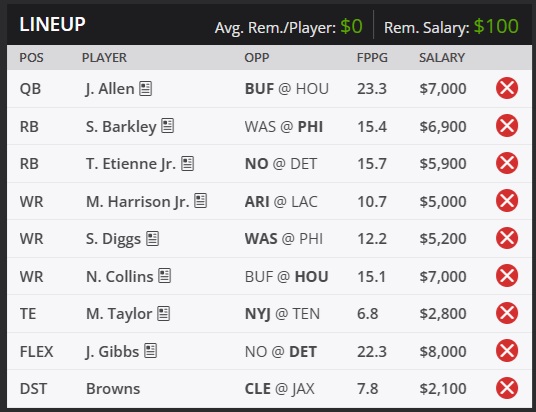
NFL Week 1 is one of the most exciting slates for daily fantasy football players because there is no shortage of uncertainty, upside and potential breakout performances. The DraftKings lineup featured here takes an aggressive approach, spending heavily on several high-ceiling running backs while using value at tight end and defense to make the salary structure work.
The lineup comes in at $49,900, leaving just $100 in salary on the table. That tells us this build was designed to maximize projected production rather than intentionally leave significant salary unused. DraftKings’ Week 1 main slate uses a $50,000 salary cap and requires a quarterback, two running backs, three wide receivers, a tight end, FLEX and defense. (DraftKings Network)
QB: Josh Allen — $7,000
The lineup starts with one of the safest high-ceiling quarterbacks on the slate: Josh Allen at $7,000.
Allen is the most expensive quarterback on DraftKings’ Week 1 main slate, but his combination of passing and rushing ability gives him an enormous fantasy ceiling. (DraftKings Network) The biggest advantage of using Allen is that he doesn’t need a massive passing performance to pay off his salary. His rushing production and touchdown upside provide additional ways to accumulate DraftKings points.
At $7,000, Allen consumes a meaningful portion of the salary cap, but the lineup compensates by finding value elsewhere.
RB: Saquon Barkley — $6,900
Saquon Barkley is an interesting Week 1 selection at $6,900. He’s priced below several of the most expensive running backs despite possessing the workload and touchdown upside necessary to post a tournament-winning score.
The matchup against Washington also gives this pick appeal. Current Week 1 fantasy analysis has Barkley among the running backs capable of outperforming his preseason ranking. (Big Blue View)
With an expected FPPG figure of 15.4 in the lineup, Barkley provides a strong blend of floor and upside without requiring an elite $7,500-plus salary.
RB: Travis Etienne Jr. — $5,900
The second running back is Travis Etienne Jr. at $5,900, providing an important salary-saving component.
Instead of pairing Allen with two premium running backs, this lineup drops down into the sub-$6,000 range for Etienne. That decision creates enough flexibility to afford several expensive receivers and Jahmyr Gibbs at FLEX.
At $5,900, Etienne doesn’t need to produce an enormous game to provide value. A solid combination of rushing attempts, receptions and touchdown opportunities could make this one of the lineup’s key value plays.
WR: Marvin Harrison Jr. — $5,000
Marvin Harrison Jr. is one of the more intriguing value receivers in the lineup.
At only $5,000, Harrison provides access to a player with considerably more upside than his salary suggests. The lineup’s listed FPPG projection of 10.7 isn’t overwhelming, but that’s precisely what creates tournament appeal. If Harrison turns his opportunity into a big-play or multi-touchdown performance, the salary savings become extremely valuable.
WR: Stefon Diggs — $5,200
Stefon Diggs at $5,200 represents another value-oriented receiver selection.
Rather than spending $7,000-plus on a receiver such as Nico Collins, this lineup attempts to capture veteran production at a reduced cost. DraftKings pricing tends to create difficult decisions between proven players and cheaper upside options, and Diggs allows this roster to spend more heavily at running back.
WR: Nico Collins — $7,000
The lineup’s biggest investment at wide receiver is Nico Collins at $7,000.
Collins is one of the slate’s most expensive receivers and was priced alongside the elite group entering Week 1. (DraftKings Network) The appeal is straightforward: if Houston-Buffalo turns into a high-volume passing game, Collins has the target share and big-play ability to justify the investment.
This also creates an interesting mini-correlation with Allen’s opponent. If Buffalo-Houston becomes a shootout, both Allen and Collins can potentially produce strong fantasy scores.
TE: Mason Taylor — $2,800
The lineup saves significant salary at tight end with Mason Taylor at $2,800.
This is one of the most important salary-saving decisions in the entire roster. Rather than paying for an elite tight end, the strategy is to accept a lower projected floor while hoping Taylor provides enough receptions or a touchdown to outperform his inexpensive salary.
At $2,800, even a modest fantasy performance can be useful if the more expensive players hit their ceilings.
FLEX: Jahmyr Gibbs — $8,000
The centerpiece of the lineup may actually be Jahmyr Gibbs at $8,000.
Gibbs entered Week 1 as DraftKings’ highest-priced player, making this a significant investment. (DraftKings Network) His inclusion demonstrates that the lineup is prioritizing elite running-back ceiling.
With a listed 22.3 FPPG projection, Gibbs has the potential to be the highest-scoring player in the lineup. Spending $8,000 at FLEX also gives the roster tremendous positional flexibility because Gibbs can produce through rushing attempts, receptions and touchdowns.
DST: Cleveland Browns — $2,100
Finally, the lineup uses the Cleveland Browns at $2,100.
Defense is another area where the build chooses savings. Instead of paying $3,000-plus for one of the most expensive defenses, the lineup takes a cheaper option and uses the savings to fund premium offensive players.
Overall DFS Strategy
The biggest takeaway from this lineup is its stars-and-value construction.
Allen, Barkley, Collins and Gibbs consume a large portion of the salary cap, while Etienne, Harrison, Diggs, Taylor and Cleveland provide the savings needed to make the lineup fit under $50,000.
The result is a roster that isn’t trying to be balanced at every position. Instead, it is betting that several elite players will deliver ceiling performances while the lower-priced selections simply need to avoid disappointing.
With $49,900 of the $50,000 DraftKings salary cap used, there is virtually no wasted salary. The lineup’s success ultimately comes down to whether the value plays can provide enough production to complement the elite core.
For Week 1 tournaments, that’s a logical strategy: pay for proven upside, identify inexpensive players with realistic paths to increased production, and use correlation and salary allocation to create a lineup capable of competing for the top of the leaderboard.