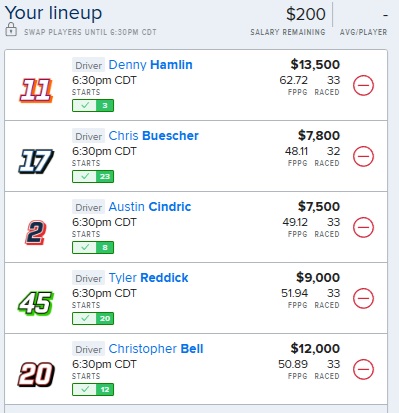
The NASCAR Cup Series heads to Bristol Motor Speedway tonight for the Bass Pro Shops Night Race, and this FanDuel DFS lineup takes an interesting approach by combining three drivers with strong upside from the middle of the starting field with two premium drivers who can rack up finishing-position points.
The lineup uses $49,800 of the $50,000 FanDuel salary cap, leaving just $200 on the table:
| Driver | Salary | Starting Position |
|---|---|---|
| Denny Hamlin | $13,500 | 3rd |
| Chris Buescher | $7,800 | 23rd |
| Austin Cindric | $7,500 | 8th |
| Tyler Reddick | $9,000 | 20th |
| Christopher Bell | $12,000 | 12th |
| Total | $49,800 |
Bristol is a particularly interesting DFS track because the race is 500 laps around the 0.533-mile concrete oval, creating plenty of opportunities for laps led, fastest-lap points and position differential. NASCAR also notes that Bristol has historically produced significant caution totals, making race management and avoiding trouble especially important.
Denny Hamlin – $13,500
Hamlin is the anchor of this lineup, and his third-place starting position gives him an excellent opportunity to score finishing-position and dominator points.
The No. 11 Toyota has an extensive history at Bristol. Hamlin has four career Bristol victories and has led more than 1,200 laps at the track. NASCAR also notes that Hamlin, Kyle Larson and Christopher Bell are the only Chase drivers entering this race with Next Gen average finishes at Bristol better than ninth.
Starting third means Hamlin doesn’t have much position-differential upside, but that isn’t necessarily the point of this selection. The goal is for him to move toward the front, lead laps and potentially contend for the win.
Hamlin also enters Bristol as the Chase points leader, making this a high-pressure race for the veteran.
Chris Buescher – $7,800
Buescher is arguably the most important value piece of this lineup.
Starting 23rd, he has considerable position-differential upside if the No. 17 Ford can work its way toward the top 15. That makes him particularly useful in a FanDuel lineup where moving forward can produce meaningful fantasy value.
NASCAR’s Bristol data shows Buescher has accumulated 30 stage points at the track among the current Chase field. More importantly for DFS purposes, outside analysis has identified his RFK Racing team as a potential value source at Bristol.
At $7,800, Buescher doesn’t need to win the race to justify the salary. A solid run from 23rd into the top 15 would provide the type of differential this lineup needs from its cheaper drivers.
Austin Cindric – $7,500
Cindric is the more aggressive value play in the lineup.
The No. 2 Ford starts eighth, so there isn’t much position-differential upside available. That means the selection is heavily dependent on Cindric’s ability to finish near or ahead of his starting position.
The upside is obvious: at just $7,500, a top-10 finish can provide useful value if Cindric stays clean and takes advantage of attrition.
There is some risk here. Bristol hasn’t historically been one of Cindric’s strongest tracks, and recent Bristol analysis has pointed out that his career record at the Tennessee short track has been inconsistent.
That makes Cindric a relatively high-variance component of the lineup, but his salary allows the lineup to fit both Hamlin and Bell.
Tyler Reddick – $9,000
Reddick is another major position-differential play.
He starts 20th, giving him 19 positions of potential movement if he reaches the front. At a track where attrition can dramatically change the running order, that starting spot creates considerable DFS upside.
Reddick has not historically posted the same Bristol numbers as Hamlin, Larson or Bell, but the starting position makes him interesting from a tournament perspective. Reddick doesn’t necessarily need to dominate the race. A move into the top 10 would make the $9,000 salary much easier to justify.
Christopher Bell – $12,000
Bell is the other premium driver and potentially the most intriguing selection in the lineup.
He starts 12th, which provides significantly more differential upside than Hamlin’s third-place starting spot. Bell also has a strong Bristol résumé, including a victory in this event last year.
NASCAR reports that Bell has finished inside the top 10 in six of his last seven Bristol starts, while he also considers Bristol one of his favorite tracks.
The No. 20 Toyota also has a particularly strong short-track profile. Bell enters the race third in the Chase standings, 18 points behind Hamlin.
Final FanDuel DFS Strategy
The construction of this lineup is fairly straightforward: pay for two potential dominators while hunting for position differential with the other three drivers.
Hamlin and Bell provide the high-end ceiling. Buescher and Reddick offer the biggest opportunity to gain positions from their starting spots, while Cindric provides salary relief.
The biggest key will be avoiding trouble. Bristol’s short track produces tight racing, lapped traffic and frequent cautions, and NASCAR reported 137 caution laps in last year’s race, the most in a Cup Series race since 1965.
One final wrinkle is that Friday’s qualifying session was canceled because of weather. The starting lineup was therefore set by NASCAR’s rulebook metrics rather than traditional qualifying speed. Hamlin starts third, Cindric eighth, Bell 12th, Reddick 20th and Buescher 23rd.
For this FanDuel build, the formula is clear: Hamlin and Bell need to provide the elite production, while Buescher and Reddick need to turn their deep starting positions into substantial position gains. If those pieces come together and Cindric holds his ground, this lineup has several different paths to a strong DFS finish.