The Bass Pro Shops Night Race at Bristol Motor Speedway presents one of the most unique DFS challenges on the NASCAR schedule. The 0.533-mile concrete bullring produces 500 laps, meaning there are plenty of opportunities to accumulate DraftKings points through laps led, fastest laps, finishing position and place differential. NASCAR also notes that Bristol has historically produced some of the highest caution totals in the sport, adding another layer of volatility to DFS lineup construction.
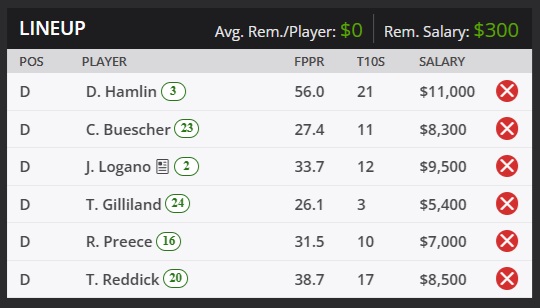
This DraftKings lineup takes an aggressive approach, combining two expensive drivers with four drivers who offer varying degrees of place-differential upside.
DraftKings Lineup
| Driver | Salary | Starting Position |
|---|---|---|
| Denny Hamlin | $11,000 | 3rd |
| Chris Buescher | $8,300 | 23rd |
| Joey Logano | $9,500 | 2nd |
| Todd Gilliland | $5,400 | 24th |
| Ryan Preece | $7,000 | 16th |
| Tyler Reddick | $8,500 | 20th |
| Total Salary | $49,700 | $300 Remaining |
The starting positions are particularly important this week because qualifying was canceled due to weather, with NASCAR setting the field according to its rulebook metrics. Logano starts second, Hamlin third, Preece 16th, Reddick 20th, Buescher 23rd and Gilliland 24th.
Denny Hamlin – $11,000
Hamlin is the highest-priced driver in this lineup and gives the roster exposure to one of the strongest Bristol performers in the field.
Starting third means Hamlin doesn’t have enormous place-differential potential, so his DraftKings value will likely come from running near the front, collecting fastest-lap points and leading laps.
That’s a realistic path at Bristol. NASCAR reports that Hamlin has four career Bristol victories and has won three of his last 11 starts at the track. He also has seven top-10 finishes in his last eight Bristol races.
With 500 laps available, a driver capable of controlling a significant portion of the race can generate a massive DFS score. Hamlin is being used here primarily for that dominator upside.
Chris Buescher – $8,300
Buescher provides the lineup with one of its biggest place-differential opportunities.
Starting 23rd, Buescher has 20 positions of potential movement before reaching the front. Obviously, he doesn’t need to finish first for this pick to work. A move into the top 15 would represent a substantial improvement from his starting position.
There is some risk. NASCAR’s current Bristol analysis points out that Buescher has struggled recently, with his team recording a best finish of only 10th over its last 11 races. He also has only 30 career Bristol stage points among the current Chase field.
Still, the $8,300 salary and 23rd-place starting position create an appealing DFS combination. This is a classic DraftKings tournament-style play where the lineup is betting on a driver outperforming his starting spot.
Joey Logano – $9,500
Logano is the highest-starting driver in the lineup and comes off the board second.
That creates a different type of DFS profile. Unlike Buescher, Gilliland, Reddick and Preece, Logano doesn’t offer significant place-differential upside. Instead, the value comes from finishing near the front and potentially leading laps.
The No. 22 Ford starts alongside pole sitter Kyle Larson, while Hamlin starts third.
Logano’s Bristol history is mixed in the Next Gen era, though, with NASCAR noting that he has averaged a 21.0 finish across seven Next Gen Bristol races.
That makes this an upside-over-floor selection. If Logano can control portions of the race and finish inside the top five, his second-place starting spot becomes much less of a concern.
Todd Gilliland – $5,400
Gilliland is the salary-saving piece that makes the rest of the lineup possible.
At only $5,400, the No. 34 Ford starts 24th. That means the ideal scenario is simple: Gilliland needs to stay out of trouble and gain positions throughout the race.
He doesn’t have to produce a spectacular finish to help this lineup. If he moves from 24th into the high teens or better, he can provide useful place-differential points while allowing the lineup to spend heavily on Hamlin and Logano.
At Bristol, survival itself can become a DFS asset. With last year’s race producing 137 caution laps, avoiding incidents can dramatically change the running order.
Ryan Preece – $7,000
Preece is one of the more interesting plays in this lineup.
He starts 16th at a $7,000 salary, giving him room to move forward without requiring a huge finish to provide value. More importantly, Bristol has been a productive track for Preece recently.
NASCAR’s Bristol preview notes that Preece has recorded top-10 finishes in two of his last four Bristol starts.
That makes him a useful middle-priced driver. If Preece can push into the top 10, this lineup gets both finishing-position production and place-differential points without requiring a premium salary.
Tyler Reddick – $8,500
Reddick rounds out the lineup with another driver starting deep in the field.
Starting 20th, Reddick has plenty of place-differential potential, but this is also one of the more volatile selections. NASCAR’s fantasy preview lists Reddick among the drivers to avoid at Bristol, noting that he has only two top-10 finishes in 10 career starts at the track.
However, Reddick did finish fourth in the spring Bristol race, which provides a recent example of the upside available from this starting position.
At $8,500, the lineup is betting that Reddick can replicate that type of performance rather than his less consistent historical results.
Final DraftKings DFS Strategy
This lineup is built around a simple concept: pay for potential dominator points with Hamlin and Logano while looking for place-differential value from the middle and lower portions of the roster.
Hamlin is the primary dominator candidate, while Logano offers another path to laps-led and fastest-lap production from the front row. Buescher, Reddick and Preece provide opportunities to gain positions, while Gilliland serves as the $5,400 salary-saving option.
The biggest variable is Bristol’s unpredictability. NASCAR describes the track as a place where “almost nothing is a given,” and last year’s 137 caution laps illustrate how quickly a DFS lineup can change.
With just $300 remaining, this is an efficient DraftKings build that emphasizes upside rather than simply loading up on the highest-priced drivers. If Hamlin or Logano controls a meaningful portion of the 500 laps and at least two of the deeper-starting drivers move significantly forward, this lineup has a clear path to a strong DraftKings DFS score.