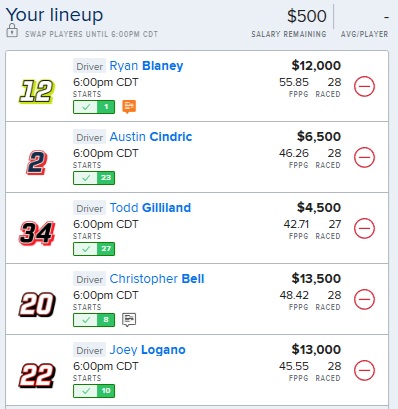
Building a strong FanDuel NASCAR DFS lineup requires more than simply selecting the five most talented drivers. Starting position, place-differential potential, finishing position, and the ability to lead laps all have to be considered when constructing a competitive roster. This Cook Out 400 lineup takes an aggressive approach by combining three expensive drivers with three value-oriented plays capable of gaining positions throughout the race.
The lineup features Ryan Blaney, Christopher Bell, Joey Logano, Austin Cindric, and Todd Gilliland. With $500 remaining in salary, the roster makes good use of the FanDuel salary cap while creating a mix of dominator potential and place-differential upside.
Martinsville is a particularly interesting track for DFS because the short, flat layout puts a premium on braking, tire management, and track position. The 2026 Cook Out 400 was scheduled for 400 laps, giving the top drivers plenty of opportunities to accumulate fantasy points through laps led and finishing position.
Ryan Blaney — $12,000
Ryan Blaney is the anchor of this FanDuel lineup.
Starting from the pole gives Blaney immediate access to one of the most important fantasy advantages at Martinsville: track position. He doesn’t have to rely on place-differential points to make this lineup work. Instead, the upside comes from leading laps, running near the front, and ultimately finishing with a strong result.
Blaney has also been a consistent contender at short tracks, and Team Penske has historically been one of the organizations capable of producing competitive Martinsville cars. NASCAR’s pre-race projections had Blaney finishing third, making him one of the strongest high-end options available.
At $12,000, Blaney needs a strong performance, but his starting position gives him an excellent opportunity to reach that ceiling.
Christopher Bell — $13,500
Christopher Bell is the most expensive driver on the roster and represents another potential race-winning option.
Starting fifth gives Bell both finishing-position upside and the opportunity to collect points if he moves toward the front. Joe Gibbs Racing has been particularly strong at Martinsville, with NASCAR noting that Hendrick Motorsports, Joe Gibbs Racing, and Team Penske had combined to dominate the track’s recent events.
Bell’s combination of speed and organization strength makes him an excellent tournament play. He doesn’t necessarily need to dominate the entire race to justify his salary. A top-five finish combined with laps led can produce a very strong FanDuel score.
Joey Logano — $13,000
Joey Logano gives this lineup another expensive driver with significant upside.
Starting 10th means Logano has more place-differential potential than Blaney or Bell. If he can move into the top five, those gained positions become especially valuable from a FanDuel perspective.
Logano also has a strong history at Virginia short tracks. NASCAR highlighted his consistency at Martinsville, noting that he had recorded 10 top-10 finishes in his previous 13 races there.
The combination of a $13,000 salary, a top-10 starting spot, and proven short-track ability makes Logano one of the safest premium selections in this lineup.
Austin Cindric — $6,500
Austin Cindric is where this lineup begins to generate significant value.
Starting 23rd gives Cindric substantial place-differential upside. Rather than needing to lead laps or win the race, his path to a strong FanDuel score is much simpler: move forward.
A top-15 finish from 23rd would represent a significant improvement in position and could make Cindric one of the most valuable drivers on the roster. NASCAR’s pre-race projection had Cindric finishing 16th, which illustrates the potential for him to gain positions from his starting spot.
At only $6,500, Cindric allows the lineup to afford three premium drivers while maintaining legitimate upside in the value range.
Todd Gilliland — $4,500
Todd Gilliland is the ultimate salary-saving play in this lineup.
At $4,500, Gilliland doesn’t need to compete for the win to provide value. Starting 27th creates plenty of room for place-differential points if he can climb through the field.
Front Row Motorsports has continued to develop its Cup Series program, and Gilliland has shown the ability to produce respectable finishes when his car is competitive. NASCAR’s pre-race projection placed him 20th, which would represent a seven-position improvement from his starting spot.
That type of movement is exactly what makes low-priced drivers attractive in FanDuel NASCAR DFS.
Why This Lineup Works
The biggest strength of this roster is its balance. Blaney, Bell, and Logano provide the high-end finishing and dominator potential, while Cindric and Gilliland offer significant place-differential upside.
The lineup also doesn’t depend on one specific driver winning the race. Blaney can score through laps led, Bell can contend for the win, Logano can gain positions, and the two value drivers can climb through the field.
That diversified approach is important in NASCAR DFS. A lineup loaded with expensive drivers can struggle if one or two favorites fail to deliver, while a roster filled exclusively with value plays may lack the ceiling necessary to win a tournament.
This FanDuel lineup instead takes the middle ground: three proven contenders paired with two drivers who have plenty of room to exceed their starting positions.
For tournament players, that combination of elite upside, place-differential potential, and salary efficiency makes this Cook Out 400 lineup an intriguing DFS build.